back to Main

Print this page


Malcolm McClay              Artist’s Statement

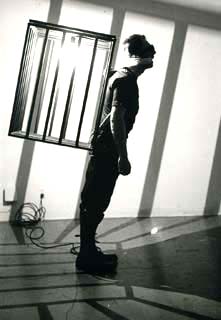
Three recurrent themes define my work:  the effect of political forces on people’s lives, the poetry of the mechanical, and an interest in viewer-activated work.

Growing up close to the border with Northern Ireland and spending four years in Belfast during “The Troubles,” I developed an interest in how political forces affect people’s lives. The individuals I became most interested in were those uninvolved yet caught both physically and psychologically in the crossfire of events. My interest in this political dynamic continues to inform my work.
                                                                       
The second recurrent theme is driven by my innate curiosity and attraction to the visual poetry of mechanical objects; this is reflected in the robotics and interactive elements I incorporate in my work.
                                                                       
The third component is an intense interest in my audience. From an early involvement in theater, my work evolved to include sound, light, movement, text, physical objects and even myself. I was less interested in blurring the lines between sculpture and theater than I was driven by a desire to find the most direct and powerful means of communicating to my audience on a visceral level. I wanted to take the metaphorical and make it a physical, tangible experience.
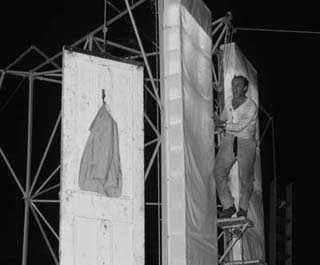
This led to the creation of a performance company that specialized in large-scale site-specific performances. These performances existed somewhere between theater and a contact sport. They were structured such that the audience became a participant rather than an observer. My work has always helped me achieve a heightened experience of life. I still retain a hunger to physically experience knowledge. After ten years of attempting to close the gap between audience and performer, I realized that the performers themselves were no longer necessary - the audience could fill that role. I made a shift from performance to interactive installation so that the audience could interact directly with the work. Spectators could gain knowledge through a physical experience, rather than a purely intellectual one.

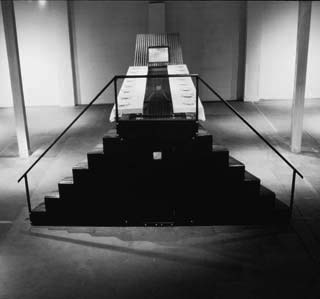
The first of these installations, Hostis, opened days after September 11th. The show was an inquiry into the “nature of enemy,” and though it was scheduled long before September 11th, it became a forum to discuss what had just happened. This was followed by Empire/Umpire, which grappled with the delicate balance between security and civil liberties. Next came The Dog Tail Wars that considered the evolution ofthe “War on Terror.” The piece consisted of a barn that housed six figures hanging upside down. The movement of the figures was driven directly by software that continuously drew information from the Internet. The shed and the activity in it thus became a conduit for other activities happening in real time worldwide related to the “War on Terror.”

As an artist dividing my time between New Orleans and Baton Rouge, I found it impossible not to respond to the devastation wrought by Hurricane Katrina. I began by creating a series of satirical drawings titled Post-Katrina Architecture that envisioned New Orleans without levee protection. This was followed by a series of linoleum prints of devastated homes from the Lower 9th Ward. I completed a video titled The Long Corridor, which documented the flooded interiors of Lower 9th Ward homes.  I have been photographing Post-Katrina New Orleans since the storm and continue to do so. This new work is a departure from my large installations but continues to address issues of human rights and social justice. Katrina brought these issues to my doorstep. I still believe as artists we are not observers of culture but participants and in all of my work I strive to raise political awareness and affect change.


back to Main